Agentic Experience Design

This case study showcases the design work I led and contributed to (2025-2026), for producing net-new, redesigned Xfinity member-facing experiences leveraging LLM technology and agentic workflows. This work is set to impact millions of Comcast Xfinity customers by the end of 2026.

Manage all your bills, accounts

Client:

Agentic Experience

Category:

Interaction Design, Prompt Engineering, Output evaluation, Prototyping | Figma Make, GitHub, Google ADK

My Role:

Designed a reusable prompt framework, conversational scripts, and agentic interactions — prototyping a production-ready, telemetry-driven repair and troubleshooting agent, plus executive demo.


Two Agentic Experiences for Xfinity Assistant

Outage communications and repair/troubleshooting agents designed for context-aware, telemetry-driven customer support.

Interactive demos

Proactive Outage Communications — minimum viable experience

Contextually aware text response, natural-language utterance and turn-taking, and rich business messaging.

Repair and Troubleshooting Agent — minimum viable web-chat experience

Overview

This page showcases two separate Xfinity Assistant (XA) projects: an SMS-based proactive outage agent and a web-chat repair and troubleshooting agent. I led the experience for the Outage Agent and contributed to the Repair and Troubleshooting Agent over time, including leading the creation of a demo for senior executives. The latter is being piloted with employees ahead of a broader customer launch.

1. Agentic Outage Experience

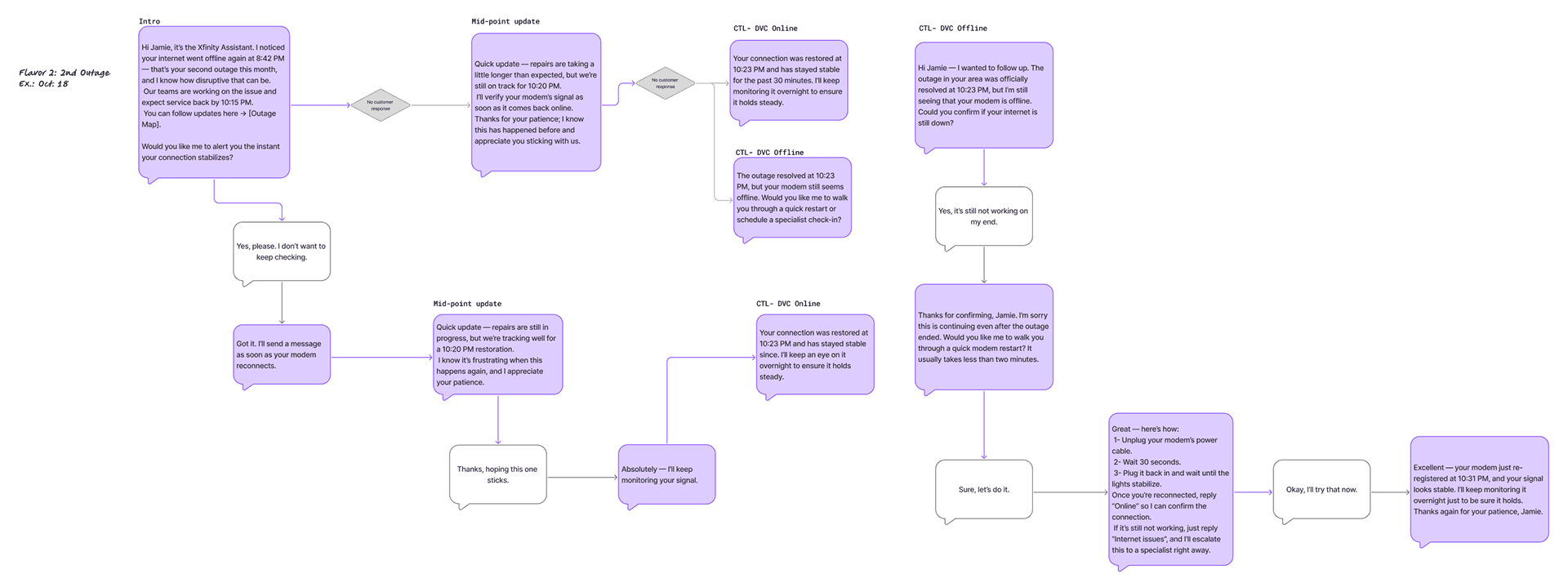
I led the design of the prompt framework and proof-of-concept demo for the 2026 next-generation outage solution, pioneering agentic and contextually intelligent messaging. The demo demonstrated three new features during a complex event where a planned network maintenance window overlapped with an unplanned severe-weather incident.

Xfinity climbed from last place in 2022 to first place in timely, reliable proactive outage communications in 2025 — J.D. Power.

The problem

Today’s outage messaging does not consistently provide members with a unified experience across planned and unplanned outage types or proactive and reactive channels. Critical updates are not always delivered in a timely manner, and automated communication does not consistently assist with outage-related inquiries. The resulting experience can feel robotic and increase effort during an already frustrating event.

Existing outage notifications can bombard members with status updates almost daily or every few days as the problem code or job type changes from planned to unplanned outage.

Goal

Deliver a unified, proactive and effortless messaging experience that drives intelligent conversations with members impacted by three or more planned or unplanned outages within a month.

My role

I designed the reusable prompt framework, conversational script, agentic interaction and proof-of-concept demo.

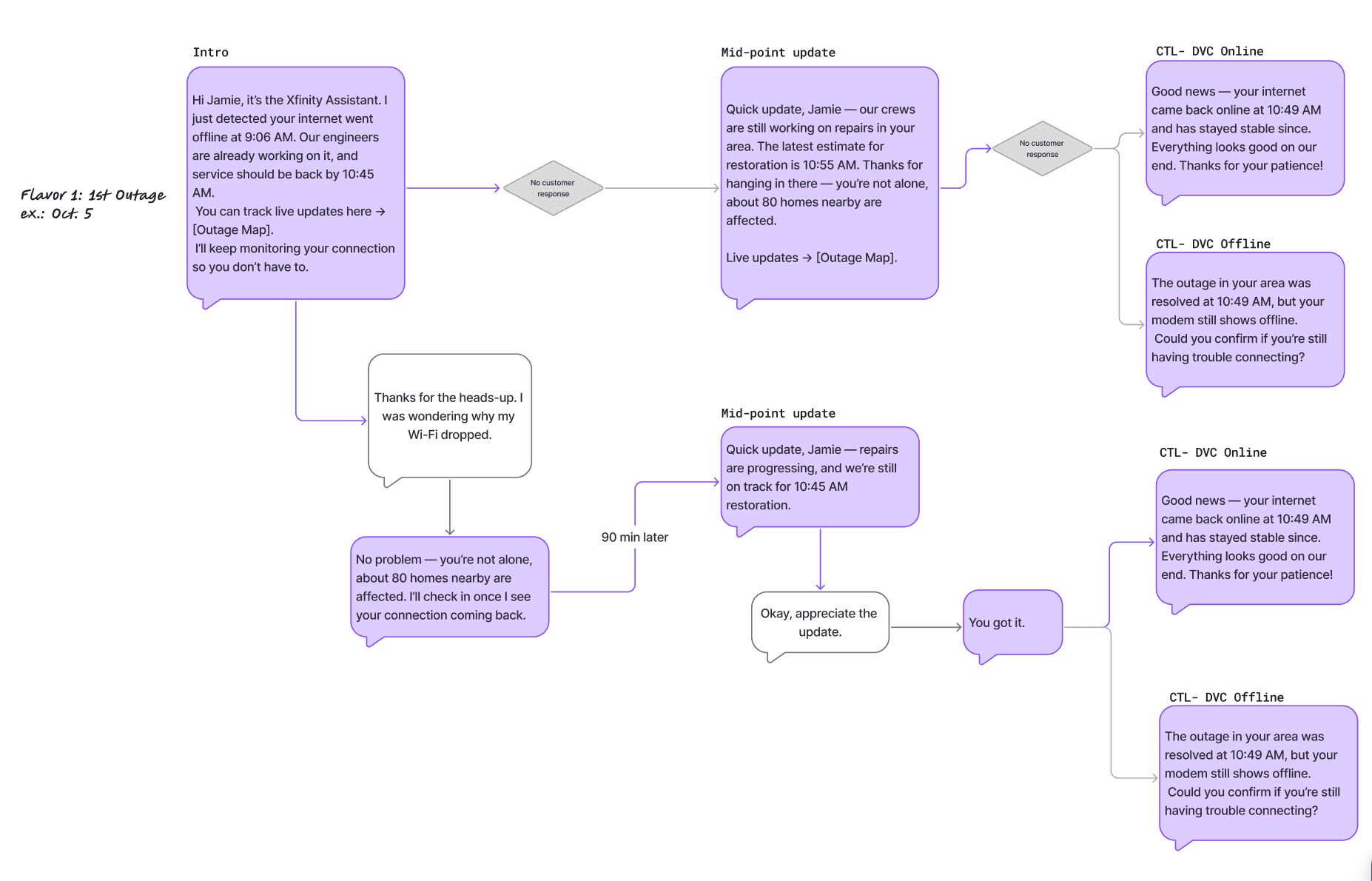
Initial concept exploration

The minimum viable experience demonstrated three capabilities: contextually aware responses, natural-language utterances with turn-taking, and rich business messaging.
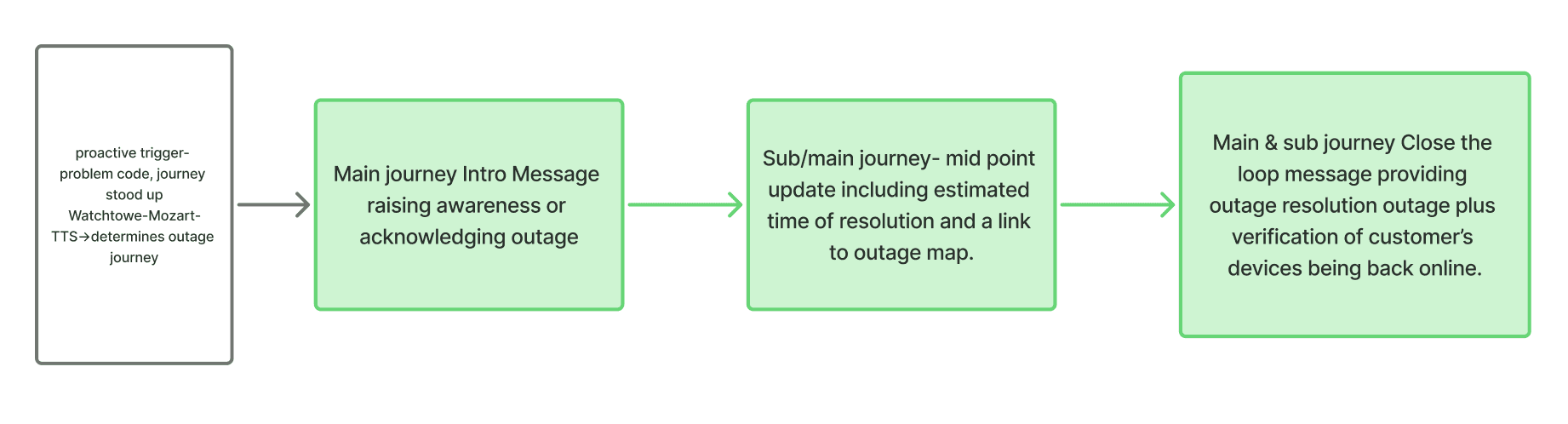
Ingredients of the reusable prompt framework

The framework brought together member and outage context, journey state, business rules, response guidance, escalation behavior and channel constraints so the agent could adapt while remaining predictable and safe.

Next steps

The next phase pairs design with engineering and solution architecture to validate technical feasibility, connect the system prompt to tools, APIs and MCP services, and prepare a first production launch. Rollout depends on broader RCS messaging availability.

2. Repair and Troubleshooting Agent

Working backward from the ideal-state visual proof of concept, I contributed to fine-tuning the repair and troubleshooting agent in a GitHub architecture connected to Google ADK (Agent Development Kit), which powered Xfinity’s customer-facing experiences. This work spanned multiple quarters and involved cross-organizational and cross-functional partners.

The problem

Approximately 482,000 high-effort customers per day experienced significant friction resolving service issues. They spent about 10.6 times longer in support, increasing operational cost and churn risk and creating a clear opportunity for GenAI optimization.

Goal

Transform guided, step-by-step troubleshooting with moment-in-time telemetry into a conversational experience informed by real-time, historical and contextual telemetry. Reduce repeat contacts across support channels.

My role

I designed the agentic interaction and prototyped a production-ready, telemetry-driven repair and troubleshooting experience.

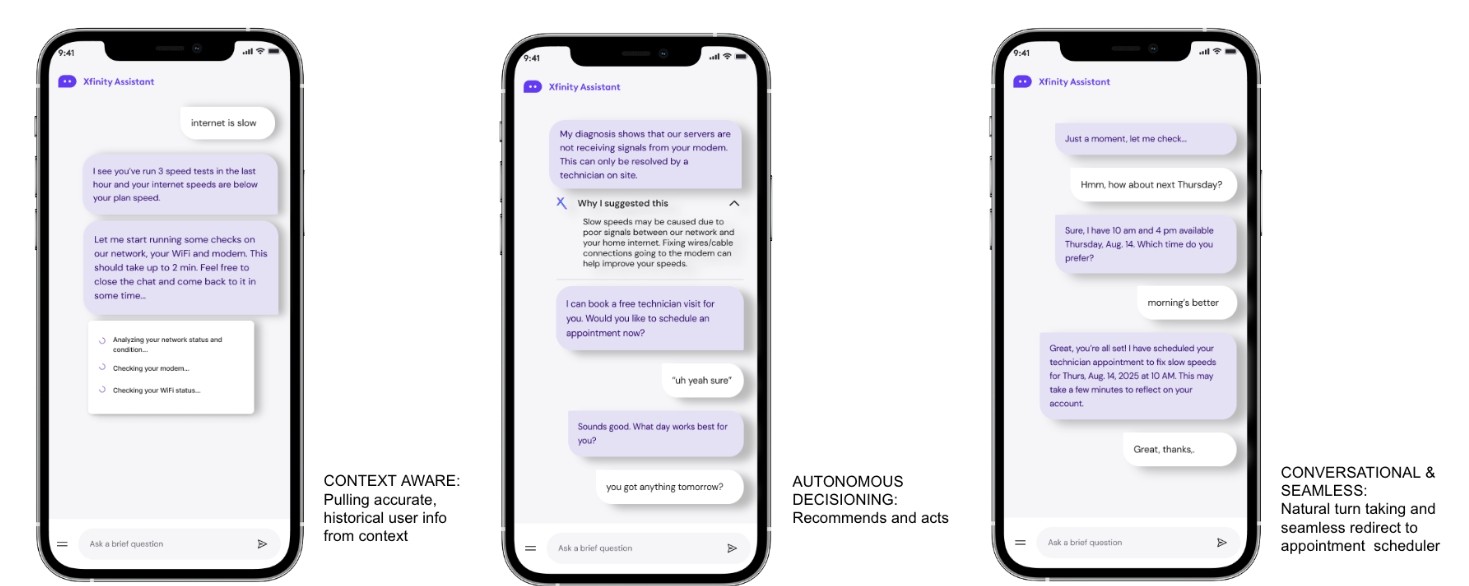
Vision and ideal-state experience

The initial exploration established the experience vision before LLM resources and technology became available for use.
Targeted areas of improvement

The prompt framework focused on stronger context retention, more effective use of telemetry, clearer response structure, reduced repetition, natural turn-taking and graceful escalation when automation could not resolve the issue.